On This Page
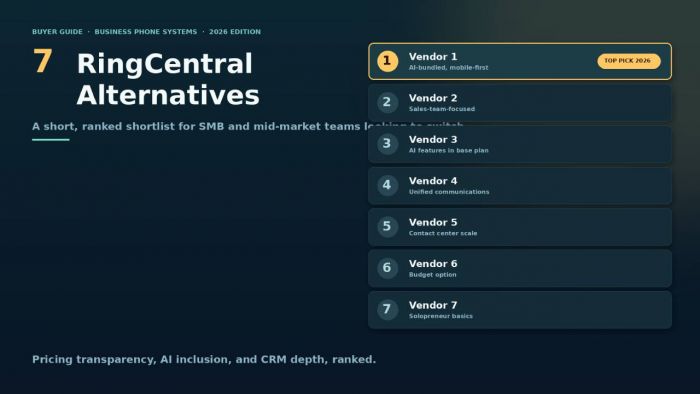
- 1. Allo — best for small teams that want AI included
- 2. Aircall — best for mid-market sales teams
- 3. Dialpad — best for AI features at a low price
- 4. Nextiva — best for unified communications
- 5. 8x8 — best for contact centers
- 6. Ooma — best for budget-conscious very small businesses
- 7. Grasshopper — best for solopreneurs who just need a number
RingCentral has been the default business phone system for two decades. It runs on every floor of every regional office in America. It also carries a 2.1-star Trustpilot rating, locks customers into contracts that are awkward to cancel by phone, and treats its AI receptionist as a $39/month add-on capped at 100 minutes.
That combination is why more small and mid-sized teams are shopping around. The category has shifted a lot in the last two years. AI-first newcomers like Allo now bundle call recording, AI summaries, an AI receptionist, and native CRM sync into the base plan with no add-ons. Sales-focused tools like Aircall have built deep CRM integrations. Heavy contact-center platforms like 8x8 cover the high end. Below are seven RingCentral alternatives worth a look in 2026, sorted by who they actually serve. Pricing reflects what was on each vendor’s public page in early 2026.
1. Allo — best for small teams that want AI included
Allo is the AI-first newcomer most often raised in the small-team conversation. Built mobile-first by the team behind Spendesk, it bundles call recording, AI summaries, an AI receptionist, and native CRM sync into a single flat plan with no add-ons.
Pricing: $25/month Starter (one user), $45/user/month Business (or $32/user/month on the annual plan). 7-day free trial. No add-ons.
Standout features
● AI Receptionist included in every plan (RingCentral charges $39/month extra for the same)
● Native CRM integrations that sync recordings, transcripts, and contact updates. The HubSpot integration is rated 5/5 on the HubSpot marketplace
● Local numbers in 50+ countries
● AI assistant lets you query past calls and SMS in plain language
Best for: SMBs and small sales teams that want AI baked in rather than bolted on.
Watch out for: No power dialer yet. Not built for 200+ seat enterprise deployments.
Ratings: G2 4.7/5, App Store 4.2/5.
2. Aircall — best for mid-market sales teams
Aircall built its reputation on being the sales-team phone system, with deep Salesforce and HubSpot integrations and a clean rep workflow. The catch is that it has moved upmarket: pricing starts at $40 per license with a three-license minimum, and AI features are an enterprise add-on.
Pricing: Essentials $40/license, Professional $70/license. Minimum 3 licenses.
Standout features
● Power Dialer and Voicemail Drop in the Professional plan
● Listen, whisper, and barge for live call coaching
● Coverage in 38 countries
Best for: Sales teams of five or more that already live in Salesforce or HubSpot.
Watch out for: The three-license minimum makes it expensive for small teams. AI is currently English and French only.
Ratings: G2 4.4/5, Trustpilot 3.2/5.
3. Dialpad — best for AI features at a low price
Dialpad has been investing in its own conversational AI model since 2018 and includes most of its AI features in every plan. Pricing is the most aggressive among the AI-included options.
Pricing: Standard $27/user/month, Pro $35/user/month.
Standout features
● AI summaries, transcription, and live coaching included in all plans (nine languages)
● Three product lines (Connect, Support, Sell) with workflows tailored to each
● Native integrations with Salesforce, HubSpot, and others; Zapier on top
Best for: SMB to mid-market teams (20–1,000 employees) that want AI without the add-on tax.
Watch out for: Multiple G2 reviews flag call-quality issues and a steep learning curve. Support wait times can be long.
Ratings: G2 4.4/5, Trustpilot 4.1/5.
4. Nextiva — best for unified communications
Nextiva is closer to a UCaaS platform than a pure phone system. It rolls voice, video, team chat, SMS, fax, and light CRM tooling into one product.
Pricing: Core $23/user/month, Engage $50/user/month, Power Suite CX $75/user/month.
Standout features
● Voice, video, team chat, SMS, online fax, and webinars in one platform
● Live chat and chatbot included on higher tiers
● AI receptionist (XBert) on premium plans
Best for: US-based SMBs that want one provider for everything.
Watch out for: The Core plan does not include call recording or CRM integrations. SMS registration can take weeks. Coverage is essentially US-only.
Ratings: G2 4.5/5, Trustpilot 4.8/5.
5. 8x8 — best for contact centers
8x8 has spent the last decade pushing toward the contact center end of the market. The product is more than what most small teams need, but for inbound-heavy operations it covers the bases.
Pricing: From $24/user/month for the base plan; contact center pricing is not public.
Standout features
● Power dialer, supervisor dashboards, and bulk text-to-speech campaigns
● Real-time transcription, sentiment analysis, and live coaching
● Coverage in 100+ countries
Best for: Contact centers and inbound support teams of 25+ agents.
Watch out for: Hard to cancel per multiple G2 reviews. CRM integrations are surface-level; their HubSpot integration is rated 1.2/5 on the HubSpot marketplace.
Ratings: G2 4.1/5, Trustpilot 3.3/5.
6. Ooma — best for budget-conscious very small businesses
Ooma is the cheapest meaningful alternative on this list, with a residential-feeling starter plan that suits one or two-person operations.
Pricing: Essentials $19.95/user/month, Pro $24.95/user/month, Pro Plus higher.
Standout features
● Cheapest entry point on this list
● Voicemail transcription on Pro and Pro Plus
● Physical handset support for businesses that want a desk phone
Best for: Solo operators and very small businesses where price is the primary driver.
Watch out for: US-only. AI features are limited to voicemail transcription. Trustpilot sits at 1.4/5, the lowest of any major business phone provider, with recurring complaints about support and connectivity.
Ratings: G2 4.6/5, Trustpilot 1.4/5.
7. Grasshopper — best for solopreneurs who just need a number
Grasshopper has been around since 2003 and used to be the default for solo business owners. It has not modernized much, but for a single-line business phone use case it still works.
Pricing: True Solo $18/month, Solo Plus $32/month, Small Business $70/month.
Standout features
● Simple, low-friction setup for a single business number
● Optional virtual receptionist via Ruby
● US and Canada coverage
Best for: Solopreneurs who need a separate business line without a full phone system.
Watch out for: No native CRM integrations. No AI features beyond voicemail transcription. The basic plan is single-user only.
Ratings: G2 3.9/5, Trustpilot 2.1/5.
How to pick the right one
If you are leaving RingCentral, the right replacement depends on what made RingCentral the wrong fit in the first place.
If price and contract terms drove you out, the AI-first newcomers (Allo, Dialpad) and the budget category (Ooma, Grasshopper) are where to start. They publish pricing publicly and let you cancel without making a phone call.
If AI features and CRM integration are the priority, Allo, Dialpad, and Aircall are the strongest matches. Allo includes AI in the base plan, Dialpad has the longest AI track record, and Aircall has the deepest sales-team integrations.
If you need a contact center or unified comms platform, 8x8 and Nextiva are the more sensible upgrades.
The shortlist test is the same regardless. Pick two or three vendors, run a 7- or 14-day trial, route real calls through each rather than dialing the vendor’s demo number, and check whether the mobile app, the CRM sync, and the AI features actually do what the marketing page promised. The product that wins this test usually wins by a meaningful margin.
Post Comment
Be the first to post comment!