Not long ago, asking an AI to generate a video from a text prompt produced something closer to a fever dream than a film. Faces warped mid-clip. Physics collapsed. A three-second loop was considered impressive.
That was 2022. In under four years, the same category of tool has crossed into professional production workflows, displaced stock footage for many use cases, and created an entirely new tier of creative work. What happened in between is worth understanding - because it explains why the tools available now look almost nothing like what launched the category.
The technical arc: three distinct phases
2022 to 2023: proof of concept, not production
The earliest text-to-video models used cascaded diffusion architectures - computationally expensive, slow to generate, and prone to temporal incoherence (the flickering, warping quality that made early clips immediately recognizable as AI). Clips ran 3 to 5 seconds at low resolution. Faces were the hardest problem: holding identity across frames while maintaining natural motion was beyond what these models could do reliably.
The first commercial tools - Runway Gen-2, Pika Labs, Stable Video Diffusion - launched in 2023 and pushed clip length to 4 to 8 seconds at 720p. Faces held better. Physics became plausible. The tools were real products, but "production-ready" was still a stretch.
2024: the architecture shift that changed everything
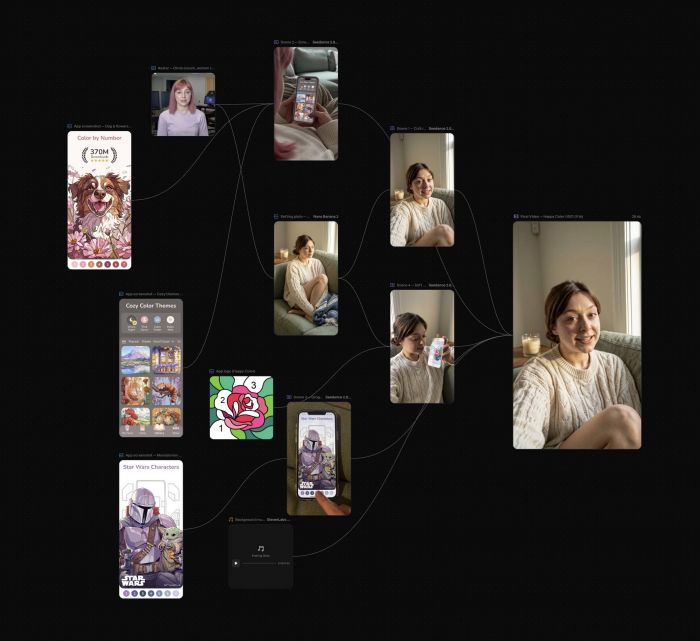
The inflection point came with diffusion transformer (DiT) models, which treat video as spatio-temporal patches rather than sequences of frames. The result was a qualitative jump: 60-second clips at 1080p with coherent motion, consistent physics, and faces that held across the full duration. Google's Veo, Runway Gen-3, Kling, and Luma Dream Machine all launched or materially upgraded in 2024, crossing what most practitioners describe as the "novelty to production tool" threshold.
2025 to 2026: control and consistency
The most recent phase solved problems that determined whether AI video was actually useful at scale rather than just impressive in demos. Camera control — dolly, crane, tracking shots specified in natural language - became standard. Image-to-video matured to the point where a single product photo could be animated while preserving style and identity. Character consistency, holding the same person across multiple clips, enabled serialized content and short-form narratives that weren't possible before. Generation speed dropped from minutes per clip to under a minute.
By mid-2025, 83% of creative professionals reported using AI tools at work, per Adobe's creator survey. That number reflects a category that had moved from experimentation to infrastructure.
Why this feels like a generational shift
The comparison that keeps coming up among practitioners is the Adobe and Canva effect. When AI features arrived in Photoshop and Canva, they didn't just speed up existing workflows - they made the manual versions of those workflows feel archaic. Younger designers entering the industry today have no memory of manual retouching as a baseline skill. It was already automated by the time they arrived.
AI video is doing the same thing to motion content. Gen Z creative professionals treat text-to-video as a default capability, not a specialized skill. The idea of manually editing every frame of a 30-second ad is already starting to feel like a previous generation's problem.
The workflow implications are real and specific:
- Ad concepting that used to take days of production now takes hours of iteration
- Storyboarding for live shoots increasingly uses AI-generated clips as pre-visualization
- Social content gets generated in platform-specific variations from a single brief
- Stock footage gets replaced with generated clips that are unique, on-brand, and don't carry licensing risk
62% of creatives say AI cuts at least 20% off their task time, and 58% report producing more content with the same resources, per the same Adobe survey. Those aren't marginal gains.
What the workforce transformation actually looks like
The adoption data breaks down along generational lines, and the divide is getting more pronounced. Younger creatives treat AI tool fluency as a core competency — on par with knowing how to use a camera or write a brief. Older professionals, including many experienced editors and directors, are more likely to use hybrid workflows: AI handles drafts, humans handle polish and judgment.
New job titles are real, if not yet standardized. AI Video Director, Generative Content Strategist, Prompt Engineer - these roles exist in agencies and in-house creative teams, and they're distinct from traditional editor or producer roles. Freelancers are building "AI-first" production packages that deliver faster and cheaper than traditional production while maintaining quality that would have required significant budgets two years ago.
The displacement question is real too and shouldn't be glossed over. Illustrators and stock photographers have been hit hardest. Illustration work dropped over 25% by early 2024 as AI-generated imagery took market share in commercial contexts. The shift isn't uniform - high-end editorial photography, fashion, and food remain domains where real production still dominates - but the middle tier of commercial stock and generic illustration is contracting.
Picking tools in this environment
The proliferation of capable tools creates its own problem. When the category was small, the choice was simple. Now there are meaningful differences between platforms optimized for cinematic quality, platforms built for ad production at scale, and platforms designed for workflow integration with existing marketing stacks.
The best AI video generators compared by use case is a more useful frame than looking for a single winner - because what matters for a performance marketing team running hundreds of ad variations is different from what matters for a filmmaker using AI for pre-visualization. Benchmark scores tell part of the story; workflow fit tells the rest.
A few things worth evaluating that don't show up in demo reels:
- Character consistency across clips (critical for brand and serialized content, still variable across tools)
- Generation speed at volume (matters more than per-clip quality when you're running A/B tests)
- Native integration with ad platforms and creative management tools
- Output control — how much can you specify camera movement, pacing, and style without re-prompting repeatedly
Where this goes next
The near-term trajectory is faster generation, longer coherent clips, and better multi-clip narrative control. Real-time generation of 1 to 2 minute clips is plausible within the next 12 to 18 months based on current improvement rates. Multi-clip narrative coherence - the same characters, same world, sequential story - is the next hard problem, and several labs are actively working on it.
The longer-term picture is harder to call precisely, but the direction isn't. Video production is becoming a creative skill with the same accessibility profile as writing or graphic design: something anyone with intent and a good tool can do at a professional level, without the equipment, crew, and budget that previously defined the category.
The creatives who will do best in that environment are the ones who treat AI fluency as a complement to creative judgment rather than a threat to it. The tools handle execution. The humans still have to know what's worth making.
Post Comment
Be the first to post comment!