On This Page
- Why Product Imagery Matters For Brands?
- What Does Traditional Product Photography Actually Cost?
- What DO AI Product Image Tools Actually Cost?
- AI Tools Vs Traditional Photography: A Simple Comparison
- The Hybrid Approach The Best Brands Are Actually Using?
- What Does This Mean For Your Brand Right Now?
- Conclusion
Every e-commerce brand hits the same wall at some point. You have great products. But getting them photographed the right way costs a lot, takes weeks, and still doesn't guarantee the results you need actually to convert browsers into buyers.
That's exactly why AI product image tools have exploded in 2026. AI tools alone aren't a magic fix. The brands that are actually winning aren't just swapping photographers for software. They're combining smart AI tools with experienced e-commerce expertise to get results faster.
Why Product Imagery Matters For Brands?
According to a study by MDG Advertising, 67% of consumers say product image quality is important when making a purchase decision online. That's higher than product descriptions, reviews, or even prices in some categories.
On Amazon specifically, listings with high-quality images see significantly better conversion rates. With Amazon's strict image guidelines, such as white backgrounds, a minimum of 1000px on the longest side. There's no room for low-quality visuals. Poor imagery doesn't just lose sales. It actively signals to shoppers that a brand isn't serious.
What Does Traditional Product Photography Actually Cost?
Traditional photography involves a professional photographer, studio space, lighting equipment, props, models (if needed), and post-production editing. For a brand photographing 20 products, a single shoot can easily cost $3,000 to $8,000, and that's before factoring in re-shoots when results don't meet expectations.
According to industry data from Rewarx, the average professional e-commerce product shoot costs between $500 and $2,000 per product when all costs are included. For a growing brand with 50+ SKUs, that number becomes unsustainable quickly. From scheduling to final delivery, traditional shoots typically take 2 to 4 weeks. In fast-moving markets, that's too slow.
What DO AI Product Image Tools Actually Cost?
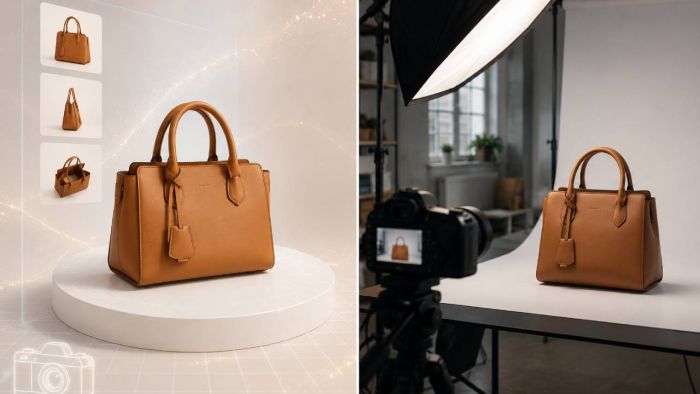
AI product photography tools operate on subscription or credit-based models. Most platforms fall in the range of $29 to $199 per month, allowing brands to generate hundreds of images without additional cost per image.
Tools like Nano Banana, used and demonstrated by eStore Factory at eStore Fest 2026 in Melbourne, can generate professional, conversion-ready product imagery from scratch without a photoshoot, a studio, or a photographer. The results are clean, platform-ready, and can be produced in minutes rather than weeks.
This represents a potential cost saving of up to 90% compared to traditional methods for brands with large or growing catalogs.
Shopify research found that e-commerce brands using AI product photography reduce their listing creation time by 73%. That means faster product launches, quicker seasonal updates, and the ability to test multiple image variations without blowing the budget.
AI Tools Vs Traditional Photography: A Simple Comparison
| Factor | Traditional Photography | AI Product Image Tools |
| Turnaround time | 2 to 4 weeks | Minutes to hours |
| Scalability | Limited by budget and time | Unlimited at flat cost |
| Consistency across catalog | Varies by shoot | High, same settings every time |
| Platform compliance (Amazon etc.) | Dependent on photographer knowledge | Configurable to spec |
| Lifestyle/contextual shots | Expensive to produce | Fast and affordable |
| Complex textures and materials | Human eye still has an edge | Improving rapidly |
| Brand storytelling and emotion | Strong, human creativity | Still developing |
| Upfront investment | High | Low |
| Ownership of assets | Full ownership | Varies by platform terms |
The Hybrid Approach The Best Brands Are Actually Using?
Here's what the data and experience show: the brands growing fastest in e-commerce aren't choosing between AI tools and traditional photography. They're using both strategically. A common approach looks like this:
● Invest in traditional photography for 5 to 10 core hero images that anchor the brand and define quality perception.
● Use AI tools for supporting images, additional angles, lifestyle shots, variations, and catalog expansion.
● Test with AI before committing to expensive shoots. Validate which product angles and backgrounds convert before spending on a full studio day.
This approach cuts total photography spend significantly while maintaining the brand quality that drives conversion on premium products.
What Does This Mean For Your Brand Right Now?
If you're an e-commerce brand or entrepreneur evaluating your product imagery strategy in 2026, here's a practical starting point:
● Audit your current photography spend. How much are you spending per product, per year? How does that compare to AI subscription costs?
● Identify which products need hero treatment. Not everything needs a full studio shoot. Prioritise.
● Test AI tools for the catalog and supporting images first. The learning curve is low, and the cost savings are immediate.
● Work with people who understand the platform, not just the tool. AI generates the image. Strategy determines whether it converts.
The AI product imagery market is projected to reach $8.9 billion by 2034, growing at a CAGR of 15.7%. This is not a passing trend. Brands that understand how to use these tools and pair them with the right expertise are building a compounding advantage over those still booking studio time for every new product.
The cost gap between brands using AI strategically and those relying entirely on traditional photography will only widen from here.
Conclusion
Product imagery has always shaped how buyers perceive a brand. AI tools have made great visuals more accessible than ever. But access to tools is not the same as knowing how to use them well. The brands that grow are the ones pairing smart technology with real e-commerce expertise.
eStore Factory works with online brands across the US, UK, and Australia to do exactly that combining AI-powered tools like Nano Banana with over a decade of hands-on Amazon and e-commerce strategy to turn product visuals into listings that actually convert.
Post Comment
Be the first to post comment!